28 statements · 7 virtues · 4 minutes
7 Heavenly Virtues Test
This free seven heavenly virtues test measures how strongly seven classical virtues show up in your everyday behaviour: humility, kindness, patience, diligence, charity, temperance, and chastity. You answer 28 statements on a seven-point scale, and the result ranks all seven. There is no sign-up.
Ready when you are
Twenty-eight statements.
Seven quiet strengths.
Answer as you actually are in an ordinary week, not as you would like to be. Nothing is timed, nothing is sent anywhere, and there are no right answers.
- 28statements
- 7virtues scored
- ~4minutes
No sign-up, no email. Answers stay in this browser.
1 / 28
Strongly disagreeStrongly agree
Press 1–7 to answer
Your leading virtue
Humility
Your seven, in order
Close behind:
When it costs you
One thing to try
You and the friend who shared this
Your answers are scored in this browser. The result link you can copy contains seven numbers and nothing else — no name, no email, no answer history.
How it works
From one statement to seven scores
The test does not count how many virtuous-sounding sentences you agree with. Each virtue has four statements, and two of them are worded in the opposite direction, so agreeing with everything will not lift your score.
01
Twenty-eight statements
Four per virtue, all drawn from ordinary moments: a slow queue, a split bag, a message you keep avoiding. None of them asks whether you are a good person.
02
A seven-point answer
From strongly disagree to strongly agree. Two statements per virtue are reverse-keyed: agreeing with “I would rather look capable than admit I need help” counts against humility, not for it.
03
One mean, one score
Reverse-keyed answers are flipped, the four answers are averaged, and that mean is mapped onto a 0–100 scale. A virtue you never chose lands near the bottom instead of vanishing.
04
A full ranking
All seven scores are drawn on a heptagon and put in order. If two virtues tie, the positively worded statements decide the lead, and the result tells you that is what happened.
What the number is not
It is not a diagnosis, a morality score, or a measure of how good a person you are. It is a snapshot of which habits you reached for during four minutes of answering. Habits move.
The seven
Meet the virtues, and the vices they answer
One line each. The classical list pairs every virtue with the vice it is said to answer; the full definitions, examples and sources live on their own page.
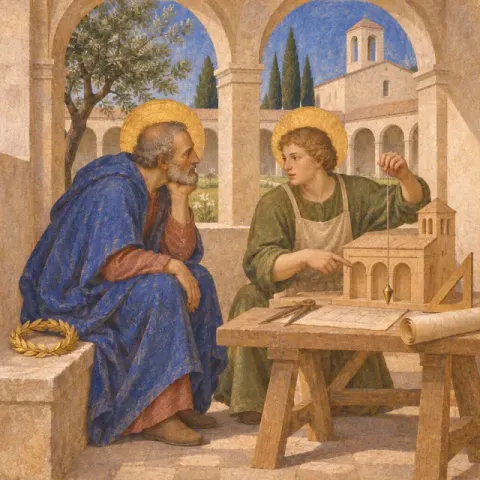
Humility
Humilitas
Answers Pride. The strength of not needing to be the most important person in the room.

Kindness
Humanitas
Answers Envy. Noticing what would make someone's hour easier — and then doing it.

Patience
Patientia
Answers Wrath. The gap between feeling frustrated and doing something about it.

Diligence
Industria
Answers Sloth. Finishing the unglamorous part, especially when nobody is watching.

Charity
Caritas
Answers Greed. Giving without turning the gift into a debt.

Temperance
Temperantia
Answers Gluttony. Enjoying things without letting them steer.

Chastity
Castitas
Answers Lust. Keeping your attention where you have decided it belongs.
Full definitions, one virtue at a time: what are the 7 heavenly virtues.
The mirror
Seven virtues, seven vices
Each virtue names a habit that makes its vice harder to practise — humility answers pride, kindness answers envy, patience answers wrath, diligence answers sloth, charity answers greed, temperance answers gluttony, chastity answers lust.
Read it as a direction rather than a scoreboard: a high kindness score does not mean you are never envious, only that envy has a well-worn alternative.
The seven-row table, where the pairing came from, and whether the two lists are really opposites: 7 heavenly virtues vs 7 deadly sins.
A worked example
What a finished result looks like
Below is one real-shaped result: kindness leads, humility is close behind, and chastity sits lowest. The lowest score is the most useful part of the page, not the least.
How to read this one
Kindness at 83 is the signature: warmth is the first thing this person reaches for. Humility at 71 is close enough to work as a pair, which is why the result mentions both.
Chastity at 38 is not a scandal. It means those four statements were rarely true — attention tends to drift, and promises can be quietly renegotiated. That is the sentence worth sitting with.
A result like this takes about four minutes and produces a 1080 × 1920 image you can keep or send.
The scale
Reading your score without flattering yourself
Every virtue lands between 0 and 100. The band tells you how reliably the habit showed up across its four statements; it does not tell you how good you are.
0–24rarely chosen
25–44situational
45–64present, uneven
65–84reliable
85–100signature
| Band | What it usually means | What to do with it |
|---|---|---|
| 0–24 | Those four statements were rarely true of you. The habit is not absent so much as untested, or quietly avoided. | Do not force it. Pick the smallest version of the habit and try it once this week. |
| 25–44 | The virtue shows up in easy conditions and disappears under pressure, fatigue, or when nobody is watching. | Notice the conditions. The score is information about context, not about character. |
| 45–64 | Present but uneven: strong in some settings, absent in others. This is the most common band. | Find the setting where it is strongest and borrow that setup elsewhere. |
| 65–84 | Reliable. Other people can probably predict this behaviour from you, which is exactly what makes it a strength. | Protect it. Strengths are often the first thing to go when you are depleted. |
| 85–100 | A signature. It is one of the first things people notice about how you move through a room. | Watch the shadow side: any virtue at full volume can harden into its own kind of rigidity. |
Questions
Everything people ask about the 7 heavenly virtues test
Where can I take the 7 heavenly virtues test?
On this page, in your own browser: 28 statements, three to five minutes, free, no account, and nothing uploaded. If you want to compare, IDRlabs and SBTI publish their own versions of the same idea — IDRlabs' quiz names the virtue that leads, SBTI's gives a seven-axis chart. This one returns a 0–100 score for all seven virtues, ranked, with a radar chart, so you see the shape rather than a single label. Taking two versions and comparing is usually more useful than hunting for the one official test; nobody owns the seven virtues.
How do I take the test, step by step?
Scroll to the top of this page — the first statement is already on screen and there is nothing to install or confirm. Answer 28 statements on a seven-point scale, one statement per screen. The result appears as soon as you answer the last statement: seven scores out of 100, a ranked order, a radar chart, and a written reading of your leading virtue. Then save the 1080 × 1920 result image or copy the link. Most people finish in three to five minutes.
Do I need to download an app?
No. The test is a web page, not an app: it runs in the browser on iPhone, Android, iPad, Windows, macOS or Linux, with no install, no account and no app store. It needs JavaScript, which every current browser has.
Does the test work on my phone?
Yes. The layout is built phone-first: one statement per screen, a scale wide enough to tap with a thumb, and the result chart and text sized for a narrow screen. The result image is 1080 × 1920 — the shape Instagram Stories and TikTok expect — so it saves straight from a phone.
What is the seven heavenly virtues test?
It is a free, browser-based self-assessment that scores seven classical virtues — humility, kindness, patience, diligence, charity, temperance, and chastity — from 28 statements about ordinary behaviour. You get a 0–100 score for every virtue, a ranked list, and a radar chart, instead of a single label.
How many questions does the test have?
Twenty-eight. Each virtue gets four statements, and two of those four are worded in the opposite direction so that agreeing with everything does not automatically raise your score.
How long does it take?
Most people finish in three to five minutes. There is no timer, and you can go back to change an answer before moving on. The result appears as soon as you answer the last statement.
Is the 7 heavenly virtues test free?
Yes. There is no account, no email, no paywall, and no advertising gate. The whole test and the result image are free to use.
Do I need to sign up or log in?
No. The test runs entirely in your browser. You can take it, save the result image, and copy a comparison link without giving any personal information.
Is this a religious test?
No. The vocabulary comes from classical and Christian ethics, but the statements are about everyday behaviour — queues, messages, credit, attention — and the result is descriptive rather than a moral judgement. People take it for fun, for journaling, or to build fictional characters.
What are the seven heavenly virtues?
Humility (humilitas), kindness (humanitas), patience (patientia), diligence (industria), charity (caritas), temperance (temperantia), and chastity (castitas). The list is a later counterpart to the seven deadly sins, and different traditions order it differently.
Where does the list of seven virtues come from?
The most influential source is Prudentius's poem Psychomachia, written around 405 CE, which stages virtues and vices as combatants. Gregory the Great fixed the seven deadly sins, and later writers — including Aquinas and Dante — developed the virtue lists that English-language sources still use.
How is each virtue scored?
Every statement is answered on a seven-point scale. Answers to the two reverse-keyed statements are flipped, the four answers for a virtue are averaged, and that average is mapped onto a 0–100 scale. A virtue you never chose lands near the bottom rather than disappearing.
Why are some statements worded negatively?
They are reverse-keyed items. Without them, a person who agrees with every sentence would score high on all seven virtues, which measures agreeableness rather than habit. The reversed items make careless agreement cost you points.
What happens if two virtues tie?
The positively worded statements decide the lead, because they are less affected by automatic agreement. If those are also tied, the stronger single answer decides; after that, the traditional order decides. The result tells you when a tie was broken this way.
What does a low score mean?
It means those four statements were rarely true of you — not that you are a bad person. A low score can mean the habit is untested, situational, or actively avoided. Unlike a trait, a habit can change with practice and circumstance.
Can my result change if I take the test again?
Yes. Answers depend on your week, your mood, and how literally you read each statement. A shift of a few points is normal; a shift of twenty usually means something real changed in how you are living, or in how honest you were.
Is this a scientifically validated personality test?
No. It is a structured self-reflection tool, not a psychometric instrument. It has not been validated against clinical or personality inventories and should not be used for hiring, diagnosis, or any high-stakes decision.
Can I take the test for a character or an OC?
Yes, and it works well for that. Answer as the character would, not as you would. The result describes the character's habits, so it is a useful way to find a virtue that leads and a shadow that complicates them.
How do I share my result?
The result screen can save a 1080 × 1920 PNG for stories, or copy a link. The link contains only your seven scores, so a friend who opens it can take the test and see both charts side by side.
Do you store my answers?
No. Scoring happens in your browser and the answers are never uploaded. Your last result may be kept in this browser's local storage so you can reopen it; the share link encodes seven numbers and nothing else.
What is the difference between the seven virtues and the seven deadly sins?
The sins describe habits that damage yourself and others; the virtues describe the habits that answer them. The popular pairing — humility against pride, kindness against envy, patience against wrath, diligence against sloth, charity against greed, temperance against gluttony, chastity against lust — is a teaching convention rather than a line-by-line map from ancient texts.
Why is chastity in the list?
Castitas is often reduced to sexual abstinence, but the older sense is integrity about desire: keeping your attention where you have decided it belongs, and not trading someone's trust for a moment of attention. In this test it is measured through statements about attention, honesty, and treating people as ends rather than options.
Can I use this for a school project or an article?
Yes. Cite this page and, where relevant, the primary sources listed at the bottom of the home page. Please describe it as an educational self-reflection tool rather than a validated psychological test.
Is this the Seven Heavenly Virtues anime quiz?
No. “The Seven Heavenly Virtues” is also the title of a 2018 anime, and people search for quizzes about its characters. This is not that quiz: there are no characters, no episodes and no plot — it scores your own everyday habits against the classical seven virtues. If you came looking for the anime, this is the wrong page, and it is worth saying so before you spend four minutes on it.
Are my scores percentiles, and how do I compare with other people?
No. Each score places you on the 0–100 scale itself, not against a population: 83 for kindness means your four kindness statements landed high on that scale, not that you are kinder than 83% of visitors. The site keeps no population averages and publishes no percentile, so compare your seven scores with each other, and with your own earlier results. A score is a snapshot of recent weeks, not a fixed trait.
Is there a limit to how many times I can take it?
No limit. There is no account to run out of, no cooldown and no payment: take it once, take it again after a hard month, and compare. The result link you copy carries your seven numbers, so whoever opens it can take the test and see both charts side by side.
What information does this site collect?
No name, no email, no account, and no answer history on a server — your answers are scored inside your browser. What does leave your browser: anonymous page-view counts (which pages were opened, with no identity attached), and anything you choose to post in the comments, which are public and moderated for spam. Your last result may stay in this browser's local storage so you can reopen it without retaking the test. The privacy page lists all of it in full.
What do I get at the end — is any of it locked?
Seven scores out of 100, a ranked order, a radar chart, and a written reading of the leading virtue: what it looks like in practice, the habit it guards against, and one practice to try this week. Nothing sits behind an email gate or a payment, there is no premium result, and there is no second half of the test to unlock.
How is this test different from other seven heavenly virtues tests?
Three differences. It scores all seven virtues on one comparable 0–100 scale instead of naming a single winner, so you can see how far ahead your leading virtue is. Two of the four statements per virtue are worded in the opposite direction, so agreeing with everything cannot lift your score. And the result arrives as numbers and a shareable image rather than a paragraph of praise. IDRlabs and SBTI test the same seven virtues with different questions and result formats; none of these is a validated psychometric instrument, and this one is built for reflection, not assessment.
Did the result get you right?
Tell us which virtue it named, or which one it missed. Comments are public and moderated for spam.
No comments yet. Start the thread with your result.